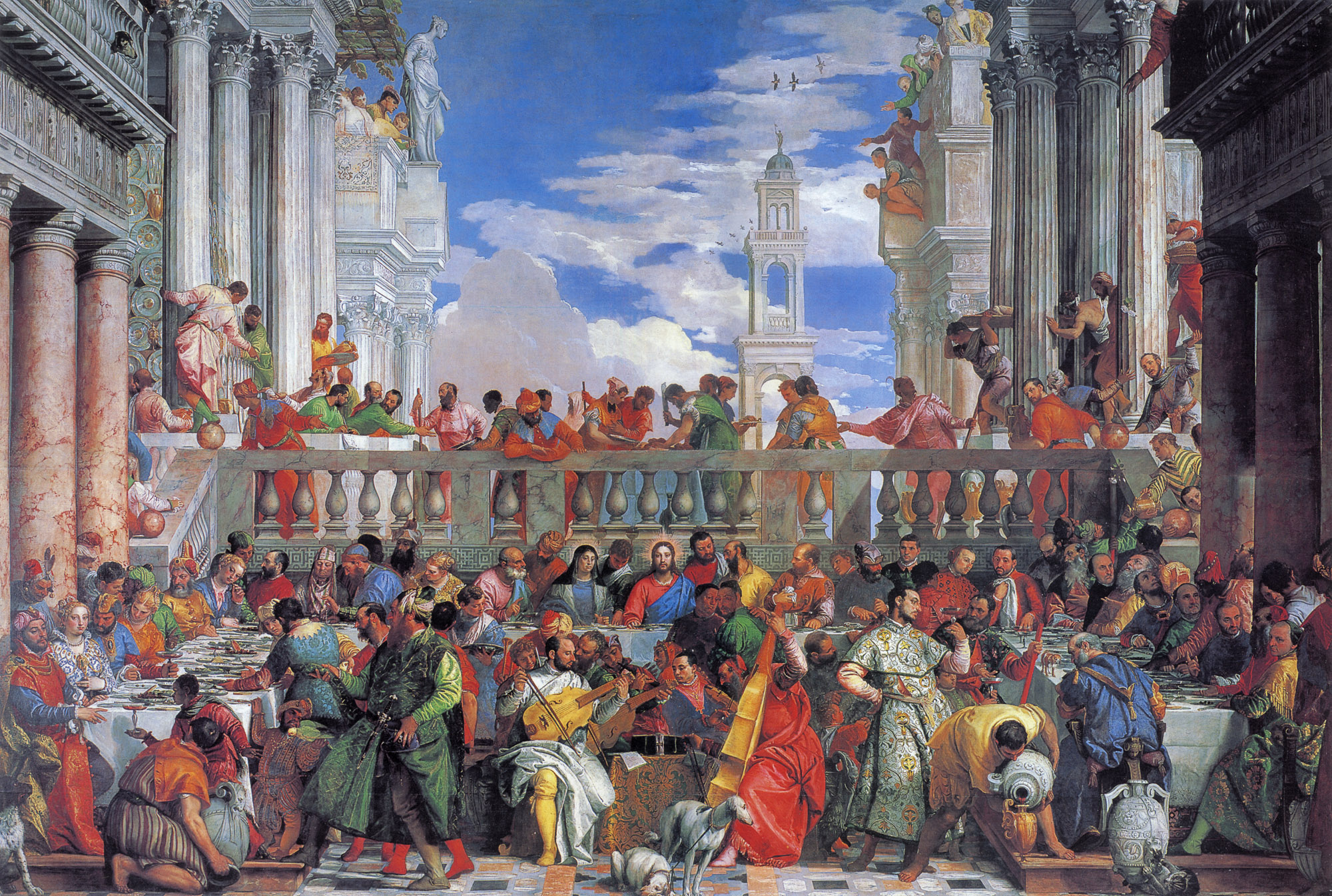
There is a room in the Louvre where the single most photographed object on Earth hangs across from a fifty square meter Venetian fever dream, and somehow everyone in that room only has eyes for the small one.
On one wall, the Mona Lisa, small enough to lose in a crowd of shoulders and phone screens, a portrait of a woman whose actual identity has been dressed up in far more mystique than the historical record probably earns. On the opposite wall, ignored, towering, practically shouting: Veronese’s Wedding at Cana, Christ’s first miracle rendered on a canvas so large it used to double as architecture. One quiet, unreadable smile draws the entire crowd. A biblical event the size of a house gets a glance on the way out. That inversion is worth a sentence, but Cana itself deserves the real attention here, since almost nobody in that room gives it any.
What Veronese Actually Built
Veronese was not interested in painting Galilee accurately. He painted a Venetian banquet in full Renaissance costume and dropped a miracle into the middle of it, happening almost as an afterthought at the far edge of the frame. Christ sits dead center, calm, robed simply, while around him the entire material culture of sixteenth century Venice unfolds in silk, jewelry, turbans and exotic pets. Only Christ, Mary and the apostles wear anything resembling timeless, placeless drapery. Everyone else is dressed like money, and that choice is deliberate rather than careless: Venice saw itself as a miracle city risen out of water, chosen and prosperous, so dressing a holy wedding in the visual language of Venetian wealth reads as the city quietly claiming its own share of grace.
The structure of the composition is where the technical intelligence really shows. Veronese splits the canvas into two registers that refuse to resolve into one clean perspective. The lower half is theater, dense with gesture, noise and the crowd’s reaction to what is happening at the table. The upper half is sober architecture and open sky, birds cutting through empty space, a register almost entirely free of human clutter. He does not force these two zones into a single unified vanishing point. The tiled floor’s lines converge above the balustrade, while the architectural lines converge instead on Christ’s halo, placed exactly at the seam between the earthly and celestial registers. The mismatch is not a mistake, it is the argument: two natures, human and divine, sharing a frame without being flattened into the same optical logic.
Then there are the details built for a viewer who lingers rather than glances: a wine flask wedged into the balustrade, a quiet preview of blood soon to be spilled at the Passion; an hourglass on the musicians’ table, ticking down a mission that has barely begun; two greyhounds sharing one leash, one gnawing a bone, the other eyeing a cat, which reads as either a wry joke about marriage or the driest visual pun on commitment in the entire Renaissance. Even the musicians carry a signature, since tradition holds that the figure in white playing the viola is Veronese’s own self portrait, seated beside a red robed figure said to be Titian, his patron and protector folded quietly into the crowd he is being compared to.
Why the Room Gets It Backwards
The Mona Lisa’s fame has almost nothing to do with what is happening inside the frame and almost everything to do with theft, scandal and a twentieth century media machine that turned a quiet portrait into a celebrity. Cana asks something harder of the viewer. It does not offer mystery through withholding, it offers meaning through excess and precision stacked in every corner of a massive canvas, and excess is somehow less seductive to a modern eye trained to prize ambiguity over abundance.
We have built a culture that worships the painting that gives us the least and walks past the one that gives us everything.
There is something almost theological in that irony, whether or not you’re a believer. The miracle at Cana is about turning absence into overflow, water into wine, insufficiency into more than enough. And in front of it, in the same room, a crowd forms around a much smaller painting precisely because it withholds, because it gives you almost nothing to hold onto except a smile you cannot quite read. Maybe that is the real lesson of standing in that room. We are not actually drawn to mystery. We are drawn to scarcity, and we mistake the two for the same thing.